
Edition 02Organization design
Part 1 · Job Design
What If the Talent Shortage Is Partly Designed?
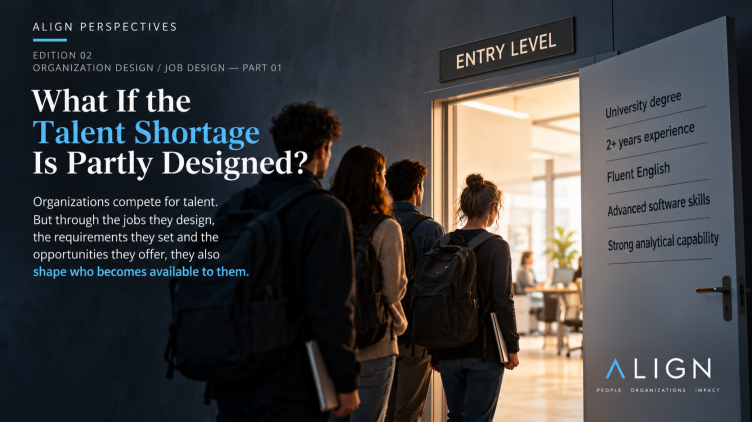
Organizations compete for talent. But through the jobs they design, the requirements they set and the opportunities they offer, they also shape who becomes available to them.

Companies say they cannot find talent.
Young people say they cannot get their first opportunity.
Both can be true.
And perhaps these are not entirely separate problems.
Organizations invest heavily in employer branding, recruitment technologies, graduate programmes, learning academies and increasingly sophisticated Talent Management systems.
Yet many entry-level positions still expect candidates to arrive with qualifications, experience and capabilities that could reasonably be developed after entering work.
We devote considerable effort to finding the right people.
But do we devote the same attention to designing the jobs through which they first enter our organizations?
The Talent Availability Paradox
Talent shortages are usually discussed as external labour-market conditions.
Not enough qualified candidates. Not enough experience. Not enough technical capability. Not enough people ready to perform.
At the same time, many young people struggle to make the transition from education into employment.
The International Labour Organization reported that 20.4% of young people aged 15–24 worldwide were neither in employment, education nor training (NEET) in 2023.1
The OECD’s Education at a Glance 2025 provides another perspective. Among 18–24-year-olds, the NEET rate in 2024 was approximately 31% in Türkiye, 17% in Italy and 16% in the United Kingdom, compared with an OECD average of 14%. In Brazil, the comparable rate was 24% in 2023, while the Netherlands recorded 5% in 2024.2
These differences are significant. But NEET is not a measure of immediately available talent.
The OECD distinguishes between unemployed NEETs, who are actively seeking work, and inactive NEETs, who are not. The indicator identifies young people outside employment and formal education or training; it does not, on its own, explain why they are there.3
Nevertheless, it raises a question worth asking.
How can substantial human potential remain disconnected from employment while organizations report difficulties finding talent?
The two conditions do not necessarily have the same cause. But looking at them together reveals an important distinction.
Talent Availability is not the same as Talent Access.
The labour market may contain people with the potential to contribute. Yet an organization can only access those who meet its entry requirements, pass its selection processes and find its employment proposition sufficiently attractive.
Organizations do not simply inherit an available talent pool.
Their own decisions influence how much of that pool they can realistically access.
Are We Designing Jobs or Ideal Candidates?
Consider a relatively structured entry-level position.
The work follows established procedures. Decisions are bounded. Much of the required knowledge can be acquired through training, supervision and experience.
Yet the job advertisement asks for a university degree, two years of relevant experience, fluent English, strong analytical capability and advanced software skills.
Some of these requirements may be essential.
Others may reflect what the organization would ideally like to have rather than what the job genuinely requires.
This is not a new concern.
Harvard Business School’s Dismissed by Degrees research examined how increasing educational requirements restricted access to jobs that had traditionally not required university degrees.4 Later research by Harvard Business School and the Burning Glass Institute found that removing degree requirements from job advertisements often produced limited changes in actual hiring.5
The issue, therefore, extends beyond what is written in a job description.
It concerns the relationship between the work, the requirements for entering it and the way candidates are ultimately selected.
This is not an argument for lowering standards. It is an argument for being more precise about them.
And that precision starts with Job Design.
Before defining the ideal candidate, we need to understand what value the job is expected to create and what capability is genuinely necessary to perform it.
Three Elements That Need to Fit
Consider three elements of an entry-level position.
- Job Demand
- What the work genuinely requires.
- Entry Demand
- What candidates must already possess to be considered and selected.
- Employment Proposition
- What the organization offers in return, including compensation, development opportunities and future prospects.
These elements do not need to be identical. But they must make sense together.
A particularly interesting misalignment occurs when organizations combine:
Low Job Demand + High Entry Demand + Low Employment Proposition.
The job may legitimately sit at a relatively modest grade, with compensation appropriate to its actual complexity and accountability.
Yet the recruitment process may favour candidates whose capabilities significantly exceed what the job requires.
The organization recruits above the job but rewards according to the job.
That creates two different risks.
First, candidates who could perform the work successfully after reasonable development may never pass the entry requirements.
Second, the people selected may find that the work offers limited opportunities to use the capabilities for which they were recruited.
Organizations sometimes recruit capability they have no job design to use.
Over time, underutilization and limited progression can contribute to dissatisfaction and turnover.
A weak employment proposition creates another difficulty: even candidates who satisfy the requirements may see insufficient value in accepting or remaining in the role.
These outcomes are not inevitable. Their significance will differ across occupations and organizations.
But the underlying design question remains.
Are the capabilities we demand, the work we offer and the opportunities we provide properly aligned?
How Do These Misalignments Emerge?
It would be too simplistic to assume that organizations deliberately create unnecessary barriers to employment.
Recruiters need efficient ways to screen applications. Hiring managers want people who can become productive quickly. Training requires investment, time and capacity. Existing job specifications provide convenient starting points.
Each of these considerations can be reasonable.
A degree requirement may simplify screening. Previous experience may reduce perceived hiring risk. A manager facing immediate delivery pressure may understandably prefer someone who requires less initial development.
The difficulty arises when these decisions are made independently of the actual design of work.
A requirement introduced for one reason becomes standard practice. A desirable capability becomes mandatory. An established job specification is reused without reconsidering whether it still reflects the work.
Over time, entry requirements can become disconnected from the job itself.
What appears rational in an individual hiring decision may create unnecessary constraints across the organization’s talent system.
And because those constraints accumulate through ordinary organizational decisions, they may not be recognized as a design problem.
That is precisely why this question belongs within Organization Design, not recruitment alone.
Talent Management May Be Starting Too Late
Organizations invest considerably in developing people once they have entered.
Onboarding, training, mentoring, performance management and career development are familiar parts of the Talent Management agenda.
But what happens before someone crosses the organizational boundary?
Who determines which potential talent pools are relevant to the business?
Who establishes what candidates genuinely need to know before joining?
Who decides what capability the organization is prepared to develop?
And who ensures that entry-level jobs offer a reasonable fit between the work, the candidate and the employment proposition?
These are not simply recruitment questions.
They are decisions about how the organization builds and accesses capability.
Entry-level jobs are not simply positions to be filled. They are the first link in the organization’s talent system.
That does not mean every entry-level position needs to become a formal development programme.
It means those jobs deserve deliberate design attention, just like any other organizational role.
Perhaps We Need to Change the Question
Talent shortages are real. Skills mismatches are real. And the difficulties young people face entering employment cannot be attributed to one organizational practice.
But employers are not passive observers of labour-market conditions.
Through Job Design, entry requirements, selection practices and employment propositions, they influence who can realistically enter their organizations.
Some constraints are external.
Others emerge from accumulated organizational choices — often without anyone intending to restrict access.
That makes talent scarcity, at least in part, an Organization Design question.
And it suggests that Talent Management may need to begin earlier than we normally assume.
So perhaps the next time we hear that an organization cannot find talent, we should ask something different.
Not simply:
Where will we find the talent?
But:
Are we designing entry-level jobs as deliberately as we design the rest of the organization?
ALIGN Perspectives — Organization Design / Job Design, Part 01.
The opening article in a series examining how Job Design influences talent access, organizational capability and performance.
References & further reading
- International Labour Organization (2024). Global Employment Trends for Youth 2024: Decent Work, Brighter Futures.
- OECD (2025). Education at a Glance 2025, Indicator A2, Table A2.1. NEET rates for ages 18–24. Brazil’s data refer to 2023; the other country figures refer to 2024.
- OECD. Youth not in employment, education or training (NEET), official indicator definition.
- Harvard Business School, Accenture & Grads of Life (2017). Dismissed by Degrees: How Degree Inflation Is Undermining U.S. Competitiveness and Hurting America’s Middle Class.
- Burning Glass Institute & Harvard Business School (2024). Skills-Based Hiring: The Long Road from Pronouncements to Practice.
Continue the conversation
A good question is enough to start.