
Edition 01Operating models
Who Owns the Operating Model?
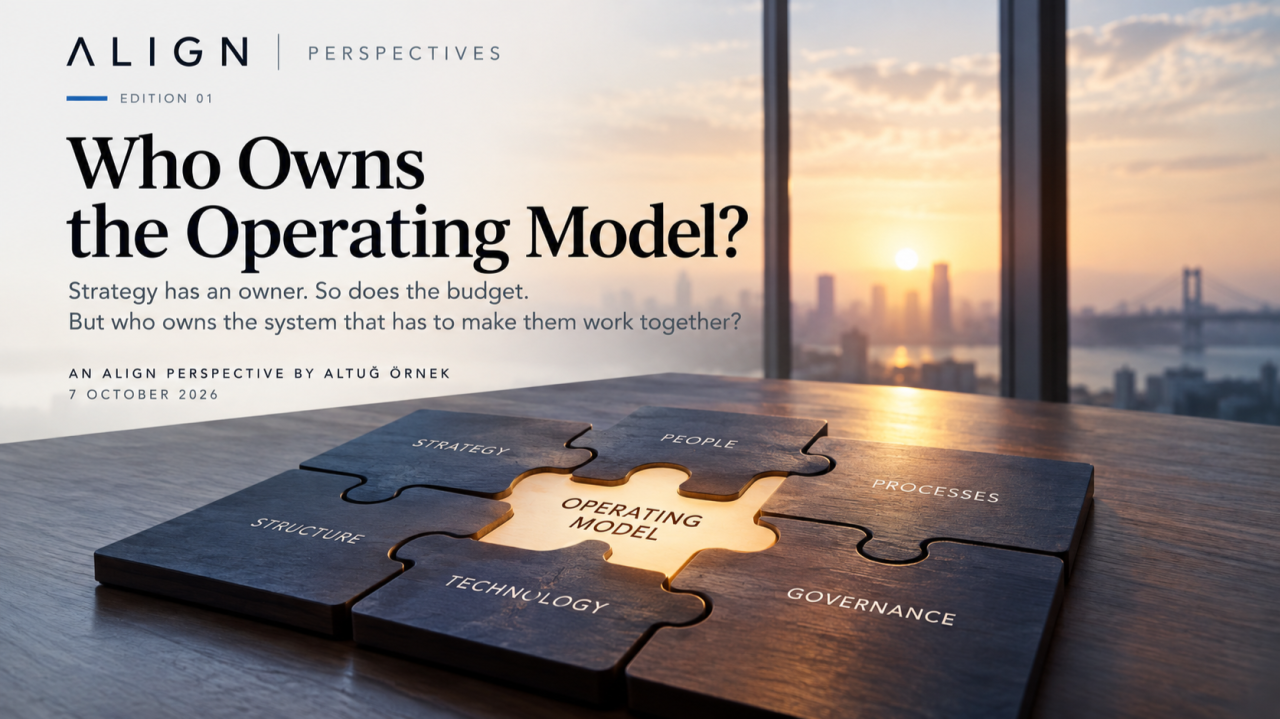
Strategy has an owner. The business model defines how value will be created. But who owns the operating model that makes it all work?

As organizations enter another planning cycle, leadership teams will review performance, set priorities, allocate budgets and agree targets for the year ahead.
Strategy has an owner. The budget has an owner. Sales targets, people plans, technology investments and transformation initiatives all have owners too.
Yet individually sensible decisions can still produce an organization that does not work as one system. That raises a question that receives far less attention:
Who owns the operating model that has to make all of those things work together?
It sounds like a governance question. It is closer to a strategy-execution and performance question.
The operating model translates strategy and the business model into the way the organization actually works. Depending on the framework, it may include structure, processes, governance, decision rights, technology, capabilities, talent, rewards, ways of working and the mechanisms by which different parts of the organization coordinate. It is not one function’s system. It is the system through which the enterprise attempts to turn strategic intent into performance.
Our working view at ALIGN is that the ownership question becomes clearer when it is separated into four responsibilities: ultimate accountability, enterprise design choices, stewardship and component ownership. The evidence does not point to one universal job title; it points to different roles in keeping the whole system coherent.
What the sources suggest
McKinsey: the CEO has the strongest ultimate claim. Its 2025 article “A new operating model for a new world” describes the operating model as a dynamic system of interdependent design choices and one of the most significant performance enablers within a CEO’s direct control.1
That gives the CEO the strongest claim to ultimate accountability — but accountability is not the same as day-to-day stewardship.
The COO: owner, operator, or steward?
McKinsey’s 2026 work on the evolving COO role adds that nuance. The COO increasingly helps mobilize strategy, translate it into execution and shape choices about operating models, capabilities, technology and talent, while formal strategic accountability remains with the CEO.2
The COO can therefore be a natural steward, integrator or principal operator of the model without being its ultimate owner.
The CHRO / CPO: enterprise architect or co-steward?
Heidrick & Struggles’ 2026 work on the emerging “enterprise CPO” adds another credible steward. It describes People leaders operating beyond traditional HR boundaries and influencing strategy, operating-model and leadership-allocation decisions.3
That does not make the CHRO or CPO the default owner. It does make the role a credible co-designer or steward where organization design, workforce architecture, leadership, culture and new ways of working are central to the model.
The executive leadership team: collective design responsibility?
Andrew Campbell and Mikel Gutierrez approach the issue from the strategy-to-execution gap. Their Operating Model Canvas treats operating-model design as a set of cross-enterprise choices required to translate strategy into operational and organizational change.4
Kates Consulting, building on Jay Galbraith’s organization-design tradition, similarly frames the Enterprise Operating Model as a sequence of enterprise design decisions linked to integration, structure and decision-making.5
If the model contains enterprise trade-offs, the executive team must be deeply involved. Centralize or decentralize? Standardize or differentiate? Where should authority sit? Where does the enterprise need integration, and where do business units need autonomy? No single function can sensibly make all of those choices alone.
But collective responsibility creates its own problem: when everybody owns something, does anybody really own it?
A named executive: the practical ownership view
Tenhaw gives one of the most direct practical answers: the finished Target Operating Model should be owned by a named executive on the client side so the design survives beyond the people who created it.
That matters when trade-offs appear, priorities compete and leaders are tempted to revert to familiar ways of working. At that point, someone needs both the mandate and authority to protect the coherence of the model.
Perhaps “ownership” is actually four different questions
The apparent disagreement becomes easier to resolve once “ownership” is separated into different responsibilities rather than forced into a single title.
- AccountabilityCEO
- Ultimately accountable for whether the enterprise is capable of delivering its strategy.
- Enterprise design choicesExecutive leadership team
- Makes the cross-enterprise trade-offs that no single function can make alone.
- Stewardship / integrationNamed leader
- Depending on context: COO, Strategy, Transformation, CHRO/CPO or equivalent. Maintains coherence across the model as priorities and conditions change.
- Component ownershipFunctions and business units
- Owns and operates the individual systems, processes, capabilities and mechanisms that form the model.
The ALIGN perspective
At ALIGN, we therefore treat the operating model as an enterprise model — not an HR, Operations, Strategy or Transformation model. Its purpose is to make the strategy executable by keeping the critical choices and components coherent.
The CEO is ultimately accountable. The executive team makes the critical enterprise choices. A clearly identified leader should steward the model’s coherence. Functions and business units own its components.
If the operating model is the system that enables strategy, someone must be accountable for the integrity of that system — not merely for one of its parts.
This is not a universal governance standard. Company size, business model, the presence or absence of a COO, the mandate of Strategy and Transformation, and the maturity of HR and Organization Effectiveness can all shift where stewardship sits.
But one principle is harder to escape: if the operating model is the system that enables strategy, someone must be accountable for the integrity of that system — not merely for one of its parts.
Why this matters during planning
Consider a leadership team entering its 2027 planning cycle. The strategy may call for greater customer centricity, faster innovation, new routes to market, AI-enabled productivity or international growth.
- Sales translates that into targets.
- Marketing develops propositions.
- Finance reallocates budget.
- Technology funds platforms and data.
- HR builds capabilities and workforce plans.
Each response can be individually sensible. Yet the enterprise can still underperform if decisions, workflows, governance, roles, measures, capabilities and incentives do not reinforce one another.
Who is responsible for asking whether all of those pieces work together as one operating model?
That is where operating-model ownership stops being an organization-design technicality and becomes a strategy-execution and performance question.
Three questions for your next leadership meeting
- Who is accountable for the coherence of our operating model — not just one of its components?
- Which operating-model trade-offs require enterprise-level decisions rather than functional decisions?
- Who has the mandate to keep the model coherent — and change it when strategy changes?
So, who owns yours?
Our answer is deliberately a perspective, not a verdict. Organizations will allocate these roles differently. What matters is whether the roles are explicit enough for the operating model to be designed, challenged, maintained and changed as strategy evolves.
CEO? COO? CHRO? Strategy? Transformation? The Executive Team? Or perhaps the more uncomfortable answer: nobody really does.
References & further reading
- McKinsey & Company. “A new operating model for a new world.” 18 June 2025. mckinsey.com
- McKinsey & Company. “The ‘bridge builder’ COO: Delivering results by engaging stakeholders.” 15 July 2026. mckinsey.com
- Heidrick & Struggles. “Chief people officer focus: 2026 agenda—becoming an enterprise CPO.” 3 February 2026. heidrick.com
- Andrew Campbell & Mikel Gutierrez. “Why You Need an Operating Model: To Align Your People and Deliver Your Strategy.” Management and Business Review, Vol. 1, Issue 2, 2021, pp. 56–66. DOI: 10.1177/2694105820210102009. journals.sagepub.com
- Kates Consulting. “Core Organization Design Frameworks” — including the Enterprise Operating Model. katesconsulting.com
Continue the conversation
A good question is enough to start.